

“TJA Annual Bowling for Charity 2026” on August 22, 2026 at Blu-O, Siam Paragon (5th Floor)
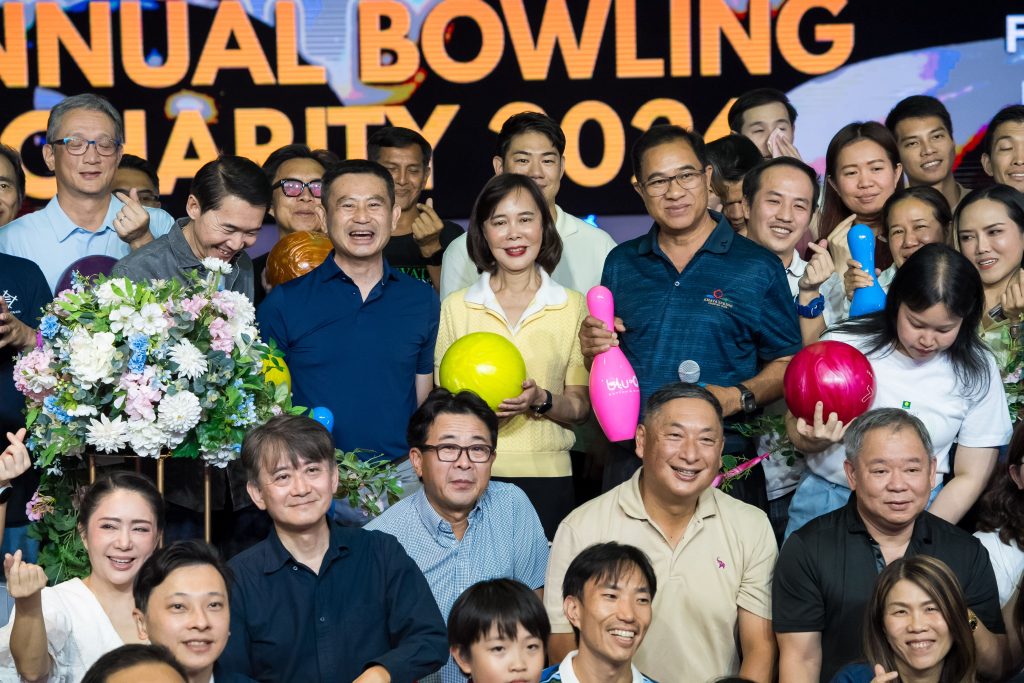
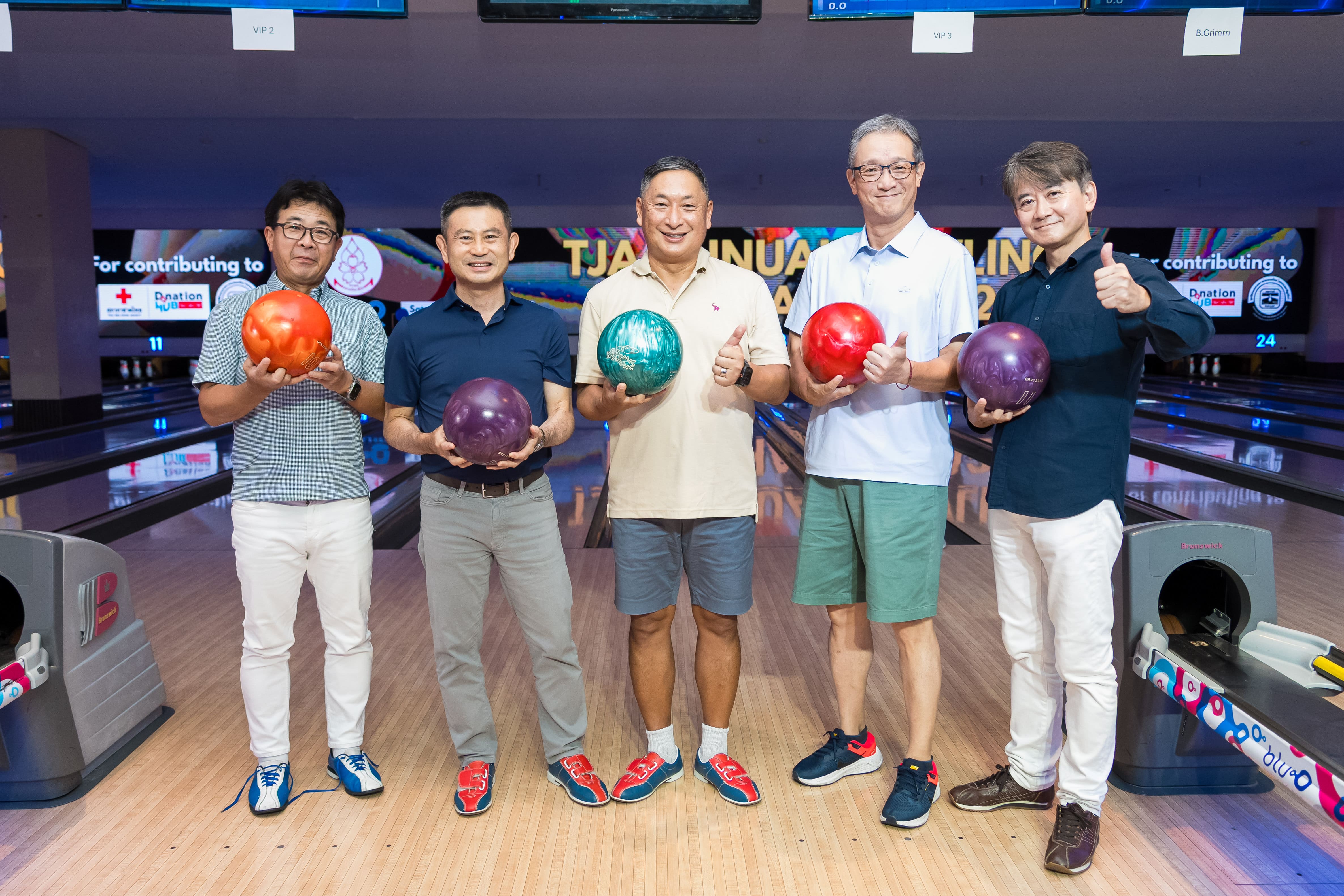
Highlights from the TJA Annual Bowling for Charity 2026 at Blu-O, Siam Paragon. With 120 players across 27 teams, we successfully raised THB 486,468 for the Thai Red Cross Society and the Foundation for the Blind in Thailand.

Upcoming Activity – “TJA Annual Bowling for Charity” at Blu-O, Siam Paragon on August 22, 2026
You are cordially invited to join our TJA Annual Bowling for Charity 2026 event. All proceeds, after expenses, will be contributed to the Thai Red Cross Society and the Foundation for the Blind in Thailand under the Royal Patronage of H.M. the Queen.

Upcoming Activity – Tanabata Wish at Japanese Village, Ayutthaya
The Star Festival “Tanabata Wish” is returning to the Japanese Village, Ayutthaya!
For visitors exploring the Japanese Village from July 1st – 24th, 2026: Receive a complimentary “Tanzaku” (短冊) to write down your dreams and hang them on bamboo branches, following Japanese tradition.

We mourn with deepest respect the passing of Her Royal Highness Princess Bajrakitiyabha Narendiradebyavati Krom Luang Rajasarinisiribajra Mahavajrarajadhita.
Her boundless grace, compassion, and countless dedications will forever be remembered and cherished in our hearts.
The Board of Executives, Advisors, and Staff of the Thai–Japanese Association

TJA Visit Baan Tawan Mai (Pol. Gen. Pow Sarasin Foundation)
Over 60 members of the Thai–Japanese Association (TJA), including the Japanese Ambassador to Thailand, Thai and Japanese executives, and their families, recently visited Baan Tawan Mai on Sunday, February 22, 2026. This home, managed by the Pol. Gen. Pow Sarasin Foundation, nurtures children and youth to ensure they grow up with the skills and quality of life needed to become the future strength of our society.


Upcoming Activity – 2026 Hanami Festival at Japanese Village, Ayutthaya
Mark your calendar for this February’s top destination, the “2026 Hanami Festival” at the Japanese Village, Ayutthaya, which will take place on February 14 to March 1, 2026. Let’s come and enjoy Sakura, dress up in Japanese attire for stunning photos, and relax with a picnic in a Japanese atmosphere.

TJA 90 Years of Friendship and Strengthening Future Collaboration: Event Highlights and Panel Summary
The Thai-Japanese Association (TJA) celebrated its 90th anniversary at the event “TJA 90 Years of Friendship and Strengthening Future Collaboration” on November 11, 2025, at The Athenee Hotel, Bangkok, welcoming 148 distinguished guests. The ceremony opened with remarks by H.E. Masato Otaka (Ambassador of Japan to Thailand), H.E. Vijavat Isarabhakdi (Vice Minister for Foreign Affairs), H.E. Arsa Sarasin (Honorary President), and Mr. Kalin Sarasin (President of the Thai-Japanese Association), reflecting on nine decades of friendship, cooperation, and shared progress between Thailand and Japan. Click here for more details


Upcoming Activity – 2025 Thai-Japanese Association Golf Tournament, on December 14, 2025 at Amata Spring Country Club, Chon Buri.
On behalf of the Thai-Japanese Association, we are delighted to invite you and your company to participate in the event “2025 TJA Annual Golf Tournament” on December 14, 2025 at Amata Spring Country Club, Chon Buri.
The Thai–Japanese Association
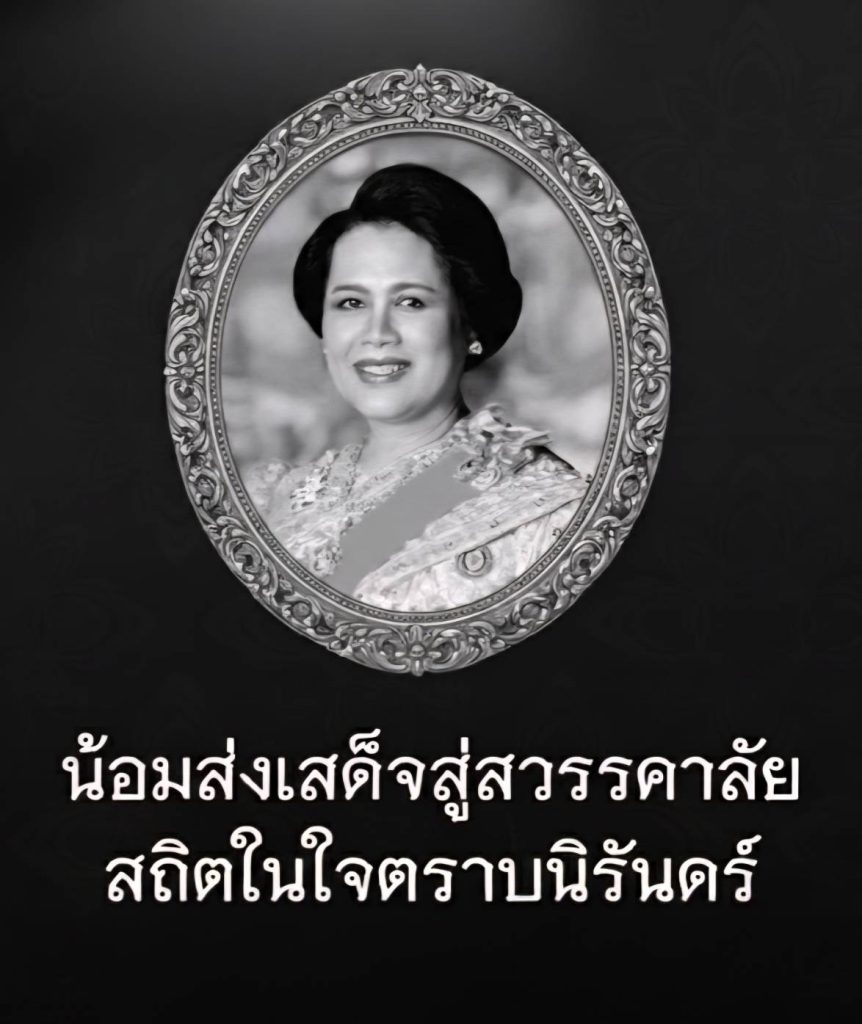
mourns with deepest respect the passing of Her Majesty Queen Sirikit, The Queen Mother.
Her boundless grace, wisdom, and compassion will forever be remembered and cherished in our hearts.
With profound sorrow and heartfelt reverence, we humbly pay tribute to Her Majesty’s everlasting legacy.

TJA 90 Years of Friendship and Strengthening Future Collaboration
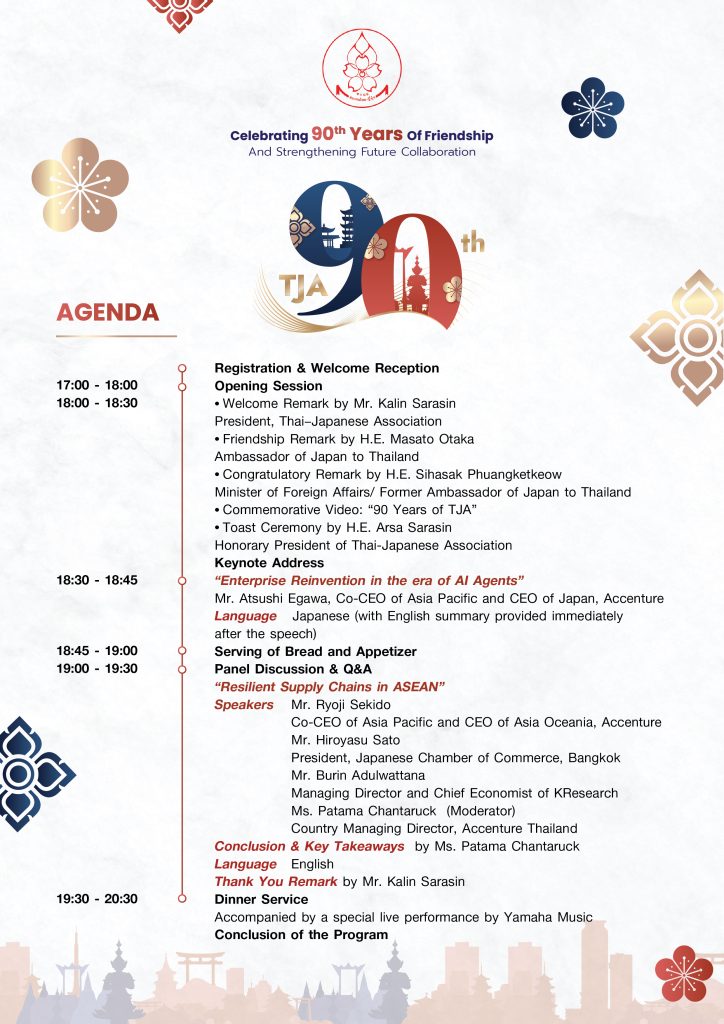
TJA 90th Anniversary Dinner, themed “Celebrating 90 Years of Friendship and Strengthening Future Collaboration” is scheduled as follows:
Date: Tuesday, 11 November 2025
Time: 17.00 – 20.30 hrs.
Venue: Pimarn Siam Hall, 29th floor, The Athenee Hotel, Bangkok
Program and Speakers
This program will feature a Keynote Address and Panel Discussion with distinguished speakers, followed by dinner and networking.
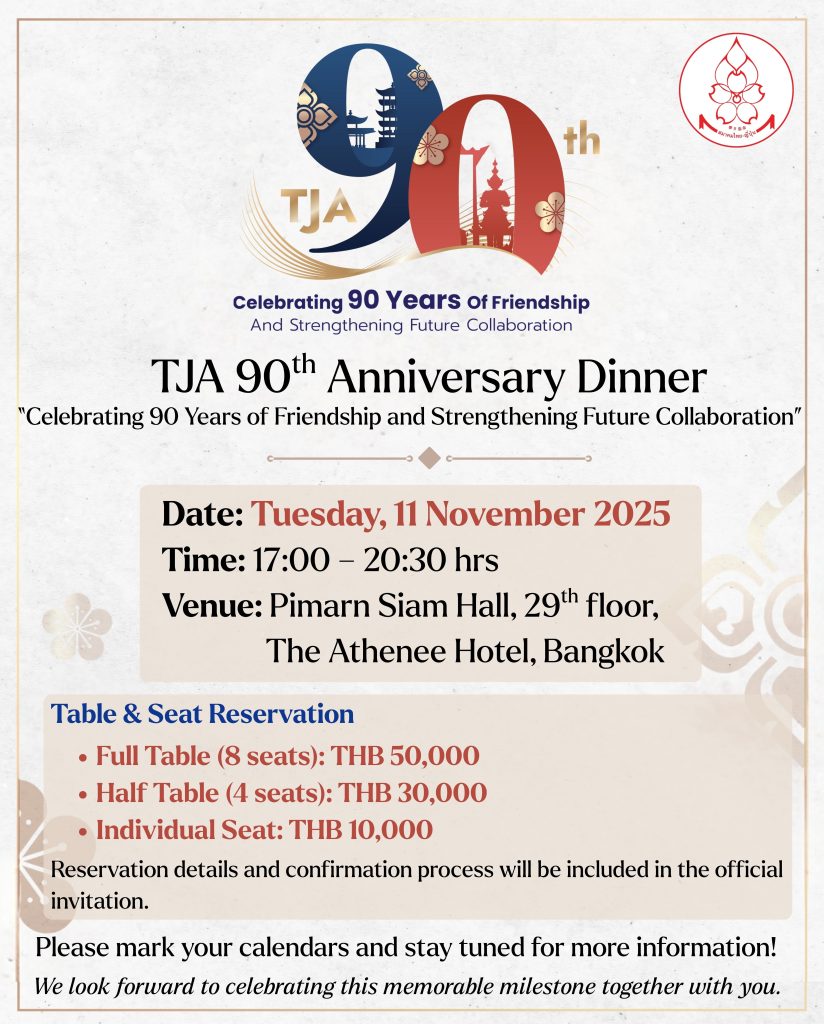
Save the Date “Celebrating 90 Years of Friendship and Strengthen Future Collaboration”
The Thai-Japanese Association is pleased to announce a special occasion to celebrate our 90th Anniversary. We warmly invite you to join us for an evening of inspiration, networking, and friendship at our TJA 90th Anniversary Dinner under the theme: “Celebrating 90 Years of Friendship and Strengthen Future Collaboration”
Date: Tuesday, 11 November 2025
Time: 17.00 – 20.30 hrs.
Venue: Pimarn Siam Hall, 29th floor, The Athenee Hotel, Bangkok
This commemorative evening will feature a Keynote Address and Panel Discussion with distinguished speakers from leading organizations, followed by dinner and networking. Further details, including the full program and list of speakers, will be shared in the official invitation.

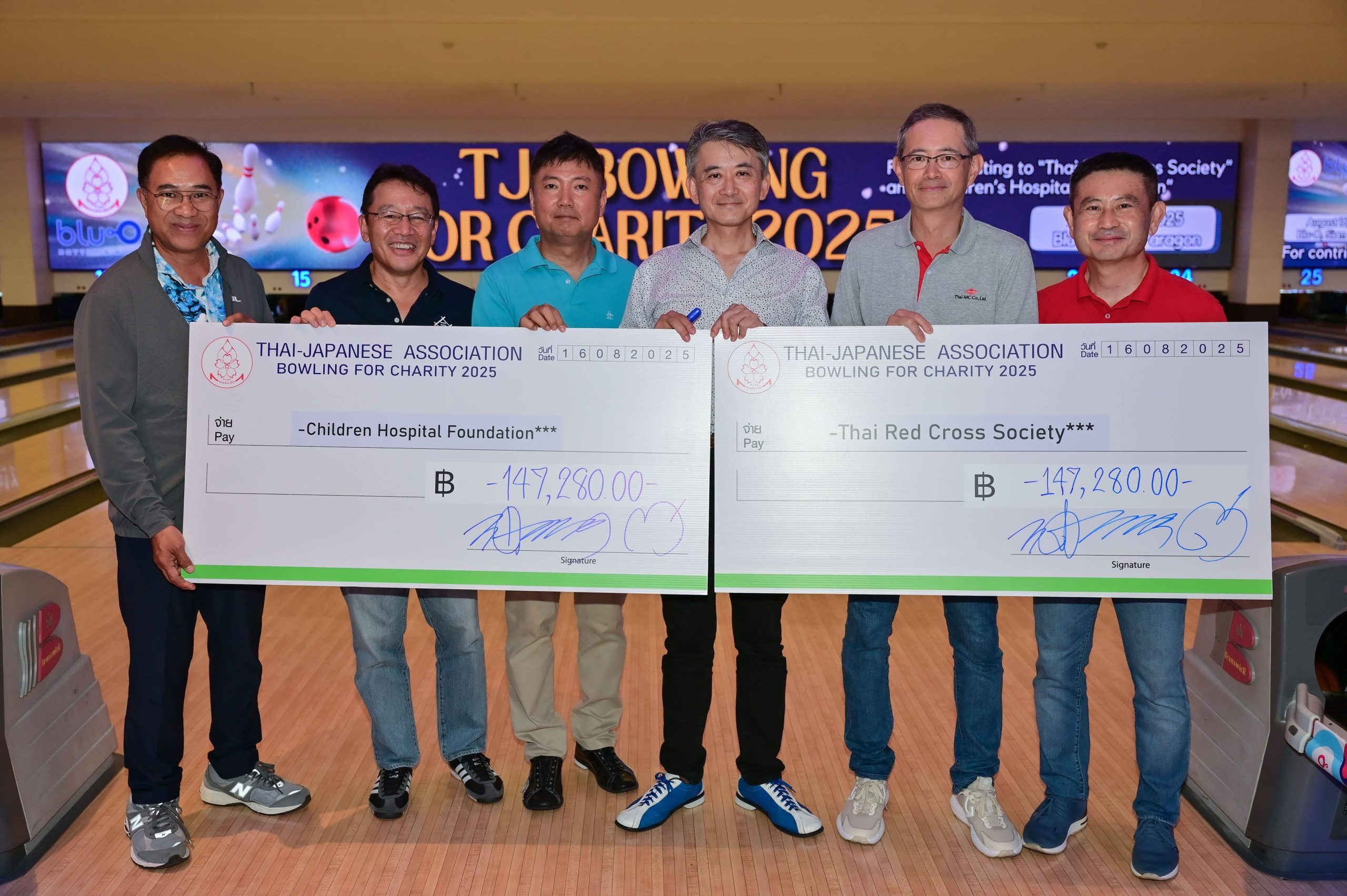
Donation to the Thai Red Cross Society and the Children’s Hospital Foundation from the TJA Bowling for Charity 2025
The Thai-Japanese Association (TJA) successfully hosted the TJA Charity Bowling 2025 event on August 16, 2025, at Blu-O, Siam Paragon. The event raised a total of THB 300,654.40 after expenses and VAT deduction. This amount was equally distributed, with THB 150,327 donated to both the Thai Red Cross Society and the Children’s Hospital Foundation.


“TJA Annual Bowling for Charity 2025” on August 16, 2025 at Blu-O, Siam Paragon (5th Floor)
The “TJA Annual Bowling for Charity 2025,” held on Saturday, August 16, 2025, from 4:00 to 6:30 p.m. at Blu-O, Siam Paragon (5th Floor), featured 122 participants and 28 bowling teams. After expenses and VAT were deducted, the event raised a total of THB 300,654.40, which will be donated to the Thai Red Cross Society and the Children’s Hospital Foundation.


“TJA Family Trip @Koh Kret” at Koh Kret, Nonthaburi on July 20, 2025
On July 20, 2025, our TJA family embarked on an enriching cultural excursion to Koh Kret, Nonthaburi Province. This special event brought together 49 members from our Thai-Japanese member companies for a day filled with unique experiences.


Upcoming Activity – “TJA Annual Bowling for Charity” at Blu-O, Siam Paragon on August 16, 2025
You are cordially invited to join our TJA Bowling for Charity 2025 event. We would like to encourage everyone to have fun and do a charitable activity at the same time. All proceeds from the event, after expenses, would be contributed to “Children Hospital Foundation” and “Thai Red Cross Society”.
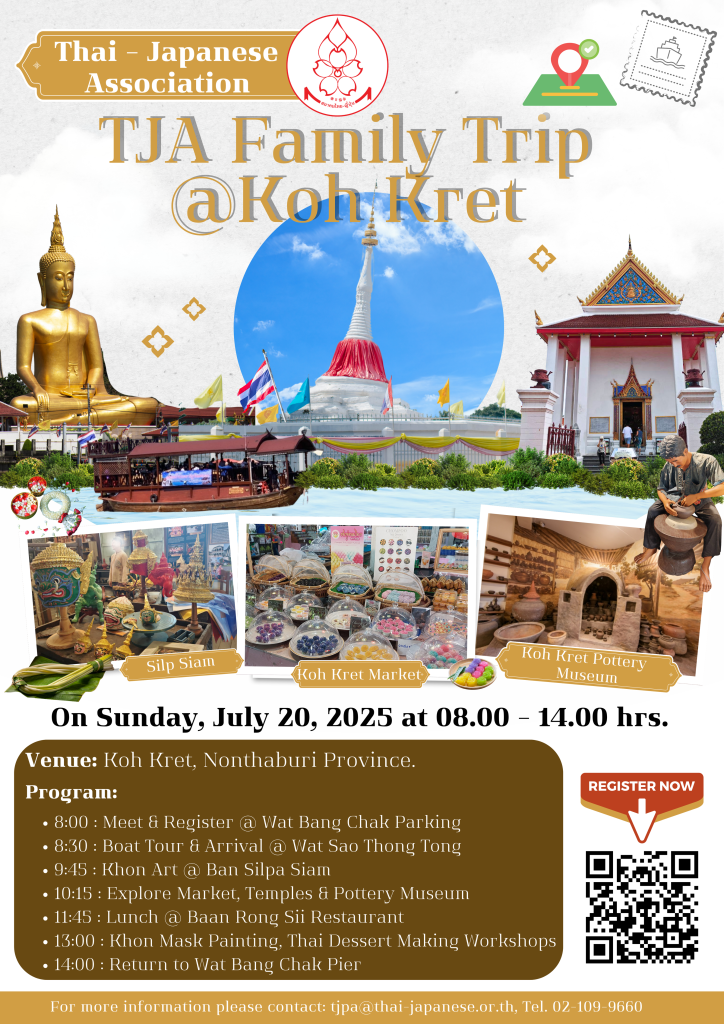
Upcoming Activity – “TJA Family Trip @ Koh Kret” at Koh Kret, Nonthaburi on July 20, 2025
We are pleased to invite you and your family to join our special cultural outing: “TJA Family Trip @ Koh Kret” on Sunday, July 20th, 2025 — a wonderful opportunity to enjoy a relaxing day, deepen connections among members, and explore the charming local culture and handicrafts of Koh Kret, Nonthaburi. For more information TJA Family Trip @ Koh Kret

“Thai – Japanese Association, Farewell Dinner” at Hard Rock Café, Ratchaprasong on March 18, 2025
The “Thai-Japanese Association Farewell Dinner” took place at Hard Rock Café, Ratchaprasong, on March 18, 2025, to honor two executive members, Mr. Kozo To and Mr. Kazuo Hidaka, upon the completion of their terms of office. The event was attended by over 60 members, reflecting strong camaraderie and support.


“Strengthening Thailand-Japan Cooperations on the Face of Renewed Trade Tensions: A Call to Action” on March 3, 2025 at Athenee Hotel, Bangkok
The seminar “Strengthening Thailand-Japan Cooperation on the Face of Renewed Trade Tensions: A Call to Action” took place on March 3, 2025, at the Athenee Hotel, Bangkok. It was organized by the Thai-Japanese Association, the Japanese Chamber of Commerce, Bangkok, and Kasikornbank. For further details, click here.


Upcoming Activity – “Strengthening Thailand-Japan Cooperations on the Face of Renewed Trade Tensions: A Call to Action” at Athenee Hotel, Bangkok
The seminar, organized by the Thai-Japanese Association and the Japanese Chamber of Commerce, Bangkok, in collaboration with KASIKORNBANK, and will take place on March 3, 2025.
e: 14.00 – 16.20 hrs. (BKK Time)
16.00 – 18.2 hrs. (TYO T

“2025 Hanami Festival” on February 1, 2025 at Japanese Village, Ayutthaya
The gathering event for TJA members at the 2025 Hanami Festival took place on Saturday, February 1, 2025, at the Japanese Village in Ayutthaya. The event featured many activities for our participants, including special performances from the Thai-Japanese Association School in Sriracha, such as “Eisa” and “Soran-Bushi.” Furthermore, students from Phra Nakhon Si Ayutthaya Rajabhat University led the Traditional Mochi Pounding Demonstration. Additionally, we had special workshops for our guests, including a Backdrop Photo Booth, a Japanese Matcha Workshop, and Cupcake Decoration.


Upcoming Activity – 2025 Hanami Festival at at Japanese Village, Ayutthaya
The “Hanami Festival 2025” will be held from January 25th to February 9th, 2025, at Japanese Village in Ayutthaya.
” Join us for the Hanami Festival at the beautiful Japanese garden along the Chao Phraya River. Traditional Yukata and Kimono rentals are available for both children and adults.”

“2024 Thai-Japanese Association Annual Golf Tournament” on December 7, 2024 at Amata Spring Country Club, Chonburi
“2024 Thai-Japanese Association Annual Golf Tournament” was held on December 7, 2024, at Amata Spring Country Club in Chonburi. This year, 34 teams and 135 golfers participated. Furthermore, we were honored to have sponsorship from 21 companies.


Donation to Thai Red Cross Society and Ramathibodi Foundation from the TJA Bowling for Charity 2024
Representatives from the Thai-Japanese Association donated funds raised from the TJA Bowling for Charity 2024 event, which took place on August 18, 2024, at Blu-O, Siam Paragon, to two charities: the Thai Red Cross Society and the Ramathibodi Foundation. After expenses and deductions, the event raised a total of THB 342,752, which was equally donated to each foundation, with each receiving THB 171,376.


News reporting “Loy Krathong Night 2024 at Japanese Village, Ayutthaya” from TNN
TNN covered the news about “Loy Krathong Night 2024 at Japanese Village, Ayutthaya” on November 17, 2024.
Link to Youtube: (38) สืบสานประเพณีลอยกระทงที่หมู่บ้านญี่ปุ่น | TNN ข่าวดึก | 17 พ.ย. 2567 – YouTube

Opening Ceremony of Loy Krathong Night 2024 at Japanese Village, Ayutthaya on November 17, 2024
We proudly celebrated the opening ceremony of Loy Krathong Night 2024 at the Japanese Village in Ayutthaya on November 17, 2024. We were honored by the presence of H.E. Mr. Masato Ohtaka – Ambassador of the Embassy of Japan to Thailand, Mr. Kalin Sarasin – President of the Thai-Japanese Association, and Mr. Watchara Krasaechat – Deputy Governor of Phra Nakhon Si Ayutthaya Province, who delivered opening speeches to our esteemed guests and visitors.
Additionally, the event featured two captivating cultural performances organized by the Tourism Authority of Thailand. The first was a “Thai Boxing Show”, followed by the mesmerizing “Lanterns of the River” performance.


Upcoming Activity – 2024 Thai-Japanese Association Golf Tournament at Amata Spring Country Club, Chon Buri
“2024 Thai-Japanese Association Golf Tournament” will be held at Amata Spring Country Club, Chon Buri on December 7, 2024, from 10:30 hrs. onward.

Upcoming Activity – Loy Krathong Night 2024 at Japanese Village, Ayutthaya
“Loy Krathong Night 2024” will be held at Japanese Village, Ayutthaya on November 15–17, 2024, from 16:00 to 20:00 hrs. (admission is free after 17:00 hrs.). There will be an opening ceremony this year on November 17, 2024.
“Let’s celebrate Loy Krathong Night amidst the beauty of the Japanese garden along the Chao Phraya River. Enjoying mesmerizing performances from TAT, live music, and floating of Krathong”

TJA Annual Bowling for Charity 2024 on August 18, 2024 at Blu-O, Siam Paragon (5th Floor).
“TJA Annual Bowling for Charity 2024” was held on Sunday, August 18th, 2024 at 16:00 hrs. – 18.30 hrs. at Blu-O, Siam Paragon (5th Floor). In this event, we had a total of 120 participants. Furthermore, we received a total donation of Baht 324,434.72 after expenses and VAT deduction. All the money donated to the Ramathibodi Foundation and the Thai Red Cross Society.


Upcoming Activity – TJA Annual Bowling for Charity 2024
The “TJA Annual Bowling for Charity 2024” would be held on Sunday, August 18th, 2024 at 16:00 – 18.30 hrs. at Blu-O, Siam Paragon (5th Floor). This year all proceeds from the event, after expenses, would be contributed to “Ramathibodi Foundation” and “Thai Red Cross Society”.

2024 Tanabata Festival (Star Festival) on July 6-7, 2024 at Japanese Village, Ayutthaya
2024 Tanabata Festival (Star Festival) held on July 6-7, 2024 at Japanese Village, Ayutthaya. It was tradition for the visitors to write a wish on a piece of paper called “Tanzuka” and hang them on bamboo tree. There were Yosakoi Sorun performence and omamori origami workshop by Thai-Nishi Institute of Technology, as well as workshop on lanthen painting for visitors.
On the same occasion, on July 7, Thai-Japanese Association hosted a heartwarming gathering party amongst members and friends with special chorus and karate performences from Thai-Japanese Association School.


TJA Dinner Cruise on June 25,2024 at The Grand Pearl Cruise – River City Bangkok Pier
This event was held on June 25,20224 at The Grand Pearl Cruise-River City Bangkok. We received recognition for hosting this wonderful dinner from Mr. Saroj Chayavivatkul of Thai Beverage Can Ltd. and Mr. Bunn Kasemsup of SCGJWD Logistics Plc.


2024 Hanami Festival (Cherry Blossom Festival) on April 6-14,2024 at Japanese Village, Ayutthaya
The event was held on April 6th – 14th, 2024 at Japanese Village. The Thai-Japanese Association was very grateful to His Excellency Ambassador Mr. Masato Ohtaka for attending the gathering event.


Thai-Japanese Association Farewell Party on February 20,2024 at Hard Rock-Ratchaprasong
The event was held on February 20th, 2024 at Hard Rock Café Bangkok. The Executive Members’ completion of the term of office.


at Japanes
e Village-Ayutthaya

at Japanese Village-Ayutthaya
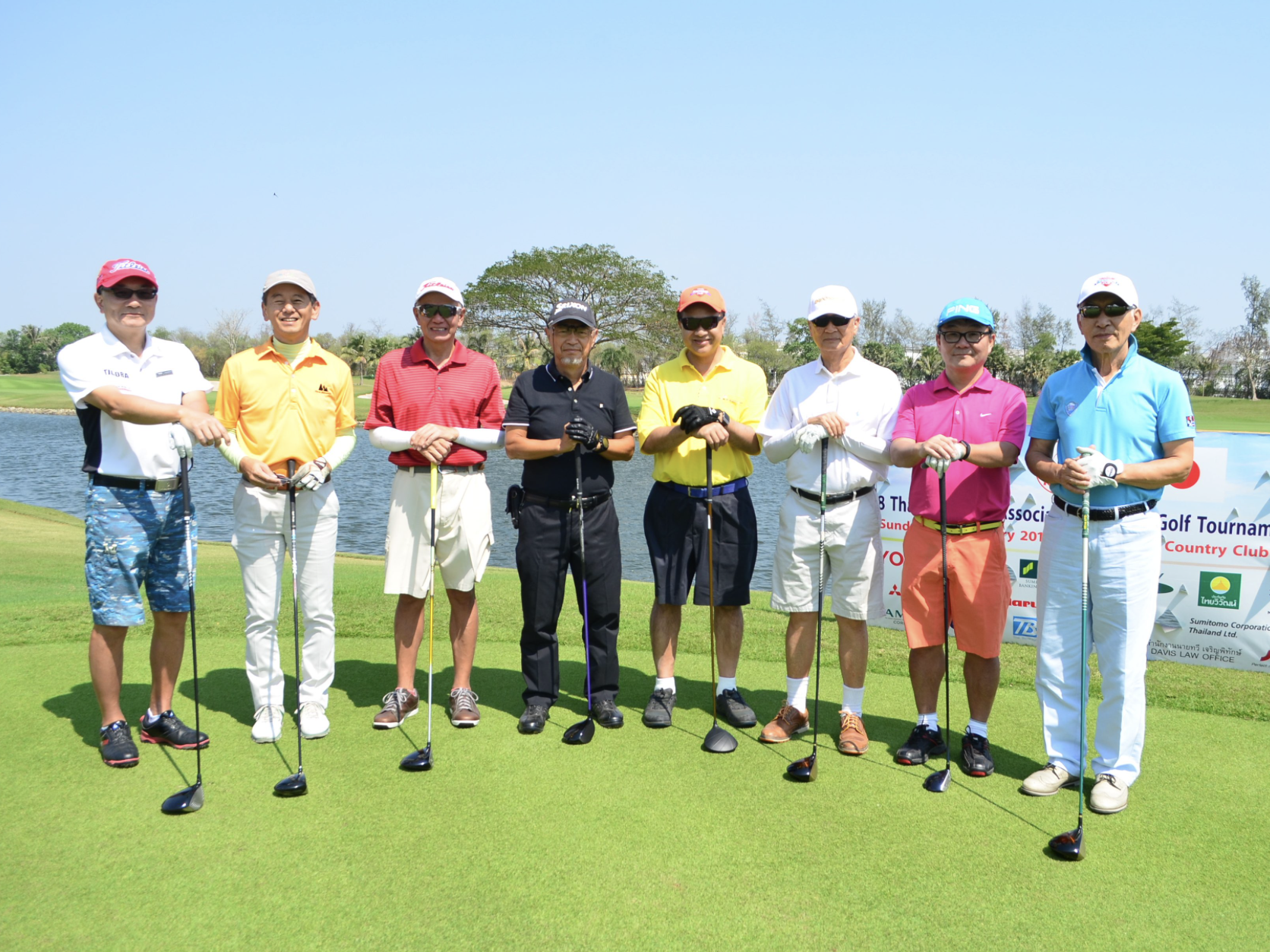
2023 Thai-Japanese Association Annual Golf Tournament on December 17,2023 at Riverdale Golf Club
The annual golf tournament for the year 2023 was held on December 17th, 2023 at Riverdale Golf and Country Club, Pathum Thani. The event achieved its objective as all participants enjoyed a fun game and had a relaxing day of friendship.


Loy Kathong Festival on November 25,2023 at Japanese Village-Ayutthaya
The event was held on November 25th, 2023 at Japanese Village-Ayutthaya. Our Thai-Japanese Association wishes to promote the beautiful Loy Krathong Festival culture across the bilateral relationship. We had a variety of activities at this event, including Japanese dance, Thai dancing, and khon performance.


at Japanese Village-Ayutthaya

TJA Annual Bowling 2023 on November 5,2023 at Blu-O Siam Paragon.
The event was held on Sunday, November 5th, 2023 at Blu-O, Siam Paragon. This year, all the net proceeds would contribute to the “Thai-Japanese Association”, to provide sustainable development for the association.


Tanabata Festival on June 8, 2023 at Japanese Village Ayutthaya.


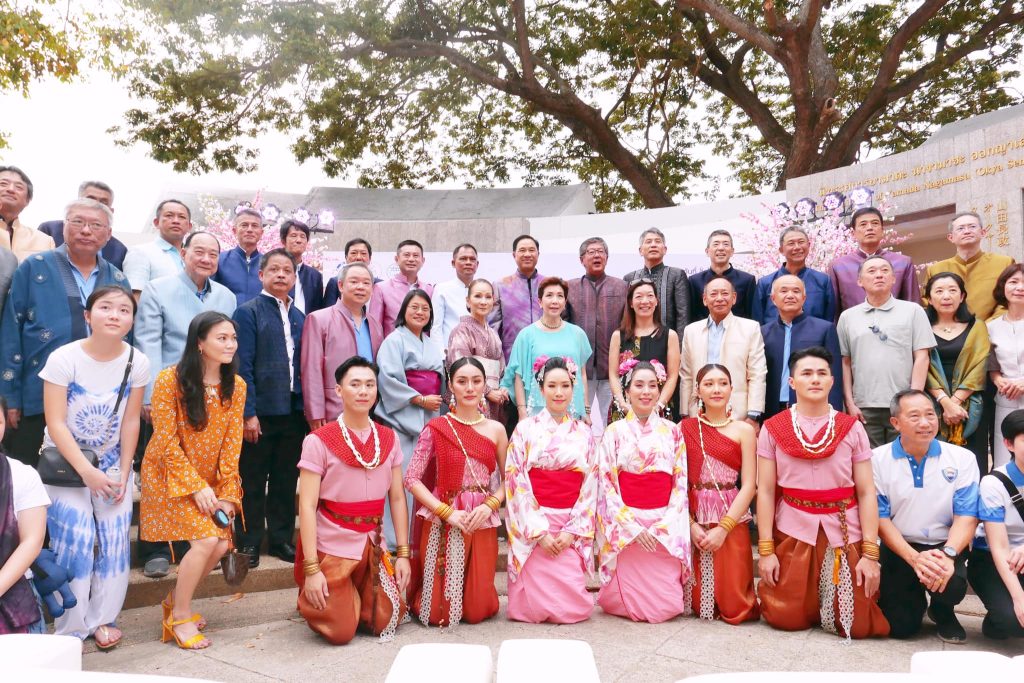
Hamani Festival on April 8, 2023 at Japanese Village Ayutthaya.


TJA Golf Tournament on December 12, 2022 at Amata Spring Country Club.





Ayutthaya.


at Japanese Village Ayutthaya.


Special Dinner Talk
“The Prime Minister Meets Japanese Businessmen” Thailand Prime Minister General Prayuth Chan-Ocha August 21, 2015

